I wrote about buying the ticket, but what’s the actual experience of taking the train like?
First up, look at the ticket:
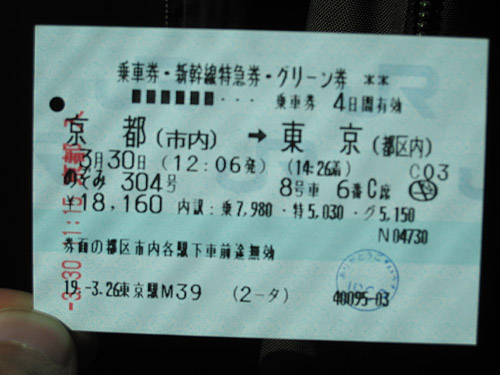
Not a lot of concessions there for the non-reader of Japanese. This is actually the ticket from Kyoto to Tokyo, although pretty much the only way I could remember was to look at the date. But really the ticket is quite straightforward. The first two lines are not important, the bulk of the information is in the middle four lines. Which say:
Kyoto->Tokyo
(date) 3/30 (time) (12:06) (arriving)(14:26)
(train number) 304 (car) 8, (row) 6, (seat) C, nosmoking
18,160 yen, 7980 for the ticket, 5,030 for reserved seat, 5,150 for green class.
Apart from the date and time and vast expense, the important things to note are the train number and the car number. You’ll first want to find out what platform your train goes from. Now we just stood and waited for the train number (63 for the Tokyo-Kyoto leg) to show up on the big board, and then we went for the platform. To get in you put your ticket in the turnstile, and take it out the other end, just like every ticket usage on Tokyo trains.
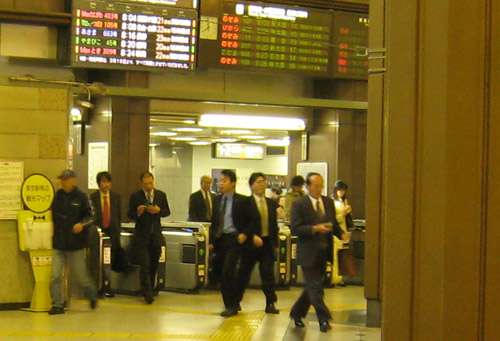
We were wondering why nobody else was waiting, then when we actually went in it turned out this was because were were basically just waiting in the entrance hall, the actual Tokyo station is HUGE. It took us a little time to find the platform. You need to look for the Shinkansen trains. If in doubt ask someone “Sumimasen, shinkansen doko desu ka?”
After that it’s very straightforward. You’ve got a train number and a car number. when you get to the platform there will be a spot on the platform where each car will end up. Above these is a sign that tells you what this train is, and what the next train is. Here it is with the sign expanded.
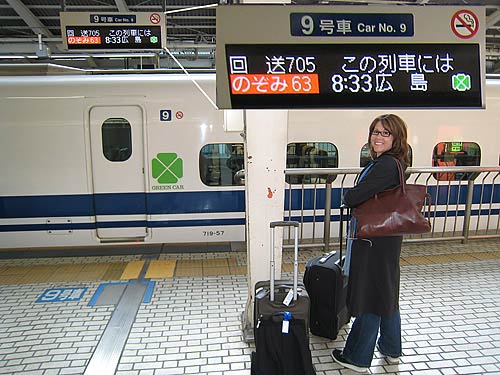
This shows the train on the platform is 705, and our train (63) is next. The green symbol means it’s green class, and the no-smoking sign means it’s no-smoking. All is well, and we just have to wait for our train. Holly is still nervous though.
But of course, the train arrived on time, we got on, found our seats and settled in for the ride. After we set off a ticket inspector comes around and puts that round stamp on the ticket. The stops are announced in English, and when we arrive in Kyoto, the exit gate will keep your ticket.
The ride itself is smooth and simple. There is a snack cart that comes around after each stop (although it’s not got a lot of stuff, so if you want to eat on the train, you should buy something at the station). You can get sake and beer to drink on the train, though again, might be best to purchase in advance. There are restrooms at the end of the cars.
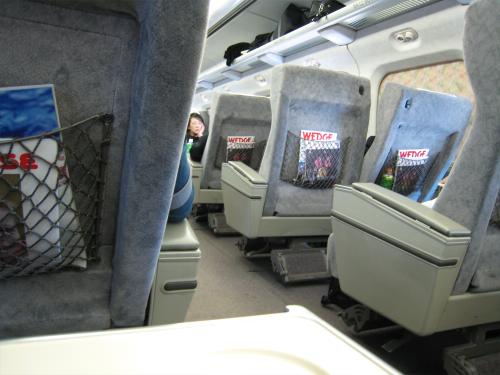
The trains run on time. We arrived at the station about an hour in advance, but there is really no need. It did take us about ten minutes to get to the platform, as the station is so big. But if you’ve got a reserved seat you should have no problem. If you don’t have a reserved seat, then you will want to line up at the non-reserved cars (which are mentioned on a sign somewhere), possibly a bit in advance – although you can’t do it too much in advance, as there is a new train every 15 minutes or so.